
If you run a 1–5 truck HVAC shop in San Antonio, your phone has two bad times to ring: when you’re in the middle of a job, and when you’re off the clock.
Both happen every week. Both are when homeowners call you. And for most small shops, both get handled the same way: the phone rings out, maybe goes to voicemail, and you “get back to them later.”
Later is usually where the job goes away. (If you want to put a number on it, start with How many jobs San Antonio HVAC owners lose to missed calls.)
This post isn’t about buying a tool. It’s about having a simple operating system for your phone: a few rules you set once so calls get caught whether you’re under a house at 2 p.m. or asleep at 11 p.m.
The real problem: no rules, just hoping
Most owner-operators don’t have a phone system. They have a phone.
It rings your cell. If you can grab it, great. If you can’t, it goes to a voicemail greeting you recorded three years ago. If the mailbox is full, the caller gets nothing at all. After hours, it’s the same thing, except you might not see the missed call until morning.
That’s not a character flaw. You’re the tech, the dispatcher, and the closer. The job in front of you wins, and it should. The fix isn’t “answer every call.” The fix is deciding ahead of time what happens when you can’t.
Here’s a system with four parts. You can set most of it up in an afternoon.
Part 1: Ring rules — who the phone rings, and for how long
Start by deciding where a call goes before it’s “missed.”
During business hours, on the job:
- Ring you first. Your business line rings your cell like it does now.
- Dual-ring a backup if you have one. A spouse who helps with the books, an office person, a second tech who’s between calls. Most business phone setups can ring two phones at once. Whoever’s free picks up.
- Keep the ring short. Don’t let it ring forever. A handful of rings is plenty before the call rolls to the next step. A caller waiting through ten rings is a caller already dialing someone else.
After hours:
- Decide if you take emergency calls at night. Be honest. If you do, forward to whoever is on call. If you don’t, skip straight to Part 2 and Part 3 and let the system hold the lead until morning.
- Don’t forward after-hours calls to a phone you keep on silent. That’s the same as no rule at all.
The goal of ring rules isn’t to answer more calls by force. It’s to give live answering a fair shot, then hand off cleanly when nobody can pick up.
Part 2: Every missed call gets a text in the first minute
This is the catch layer, and it’s the part most small shops are missing.
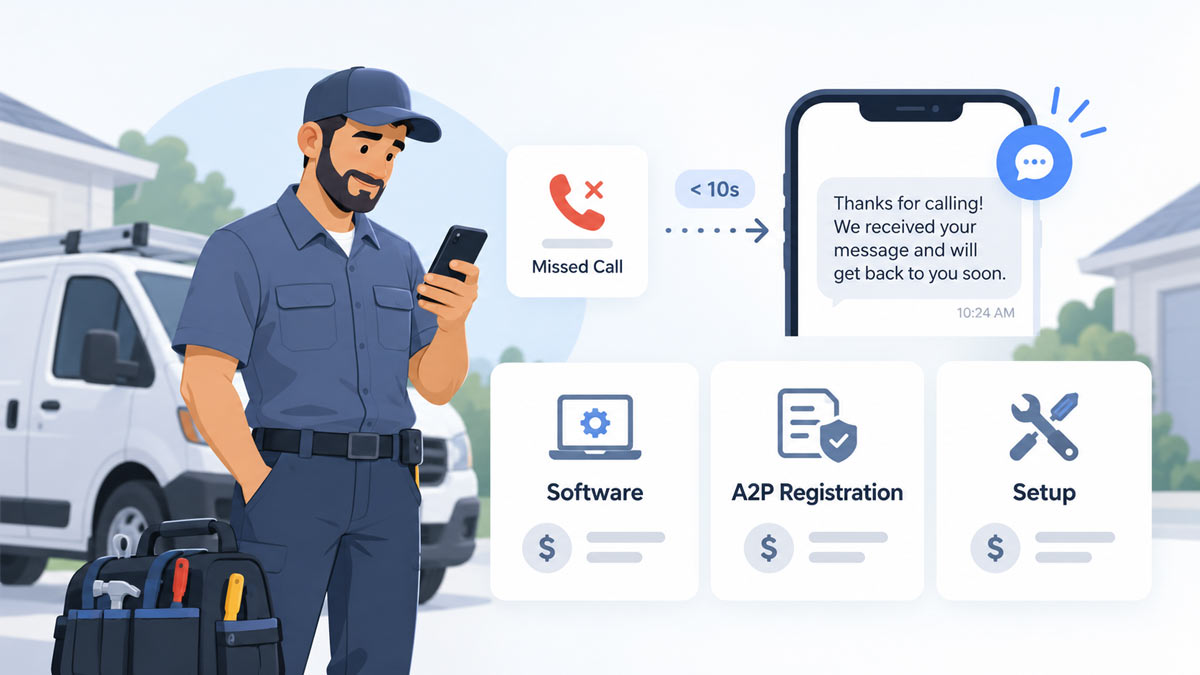
When a call rings out or hits voicemail, the caller should get a text from your business number within about a minute. Not an hour later when you check your phone. Within the minute, while they’re still holding the phone and deciding who to call next.
A good on-the-job text looks like this:
“Hi, this is [Shop Name] — sorry we missed your call, we’re on a job right now. What’s going on with your system? Reply here and we’ll get you scheduled.”
Why that works:
- Your shop name is in it. They know who’s texting.
- It explains the miss. “On a job” sounds busy and legit, not ignored.
- It asks one easy question. “What’s going on?” gets a reply. “Please call us back during business hours” doesn’t.
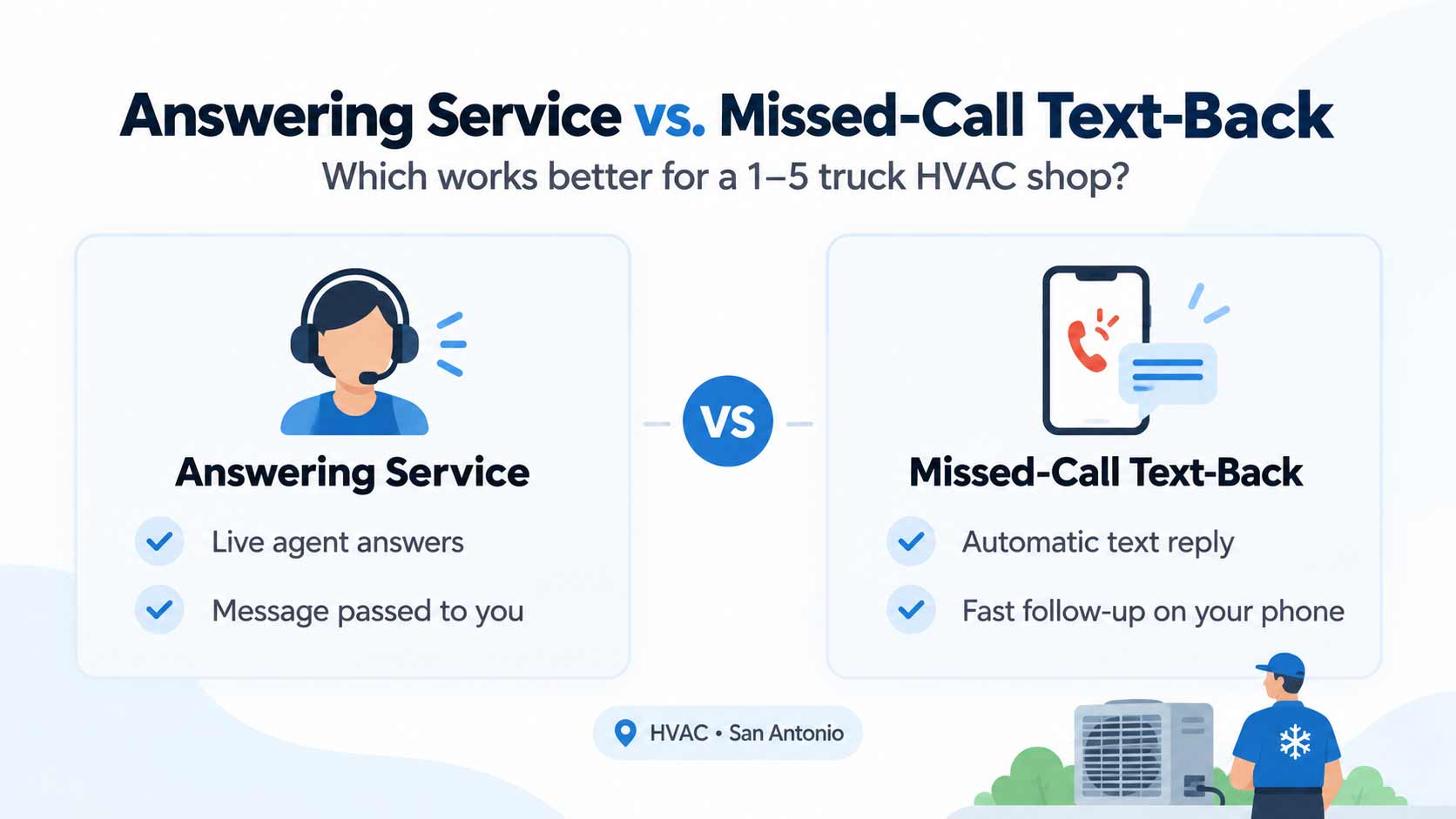
Plenty of homeowners won’t leave a voicemail. Almost everyone will answer a text. That first-minute text is what keeps you in the conversation while your hands are full. We compared this approach to live answering in Missed-call text-back vs answering service for small HVAC shops if you’re weighing the two.
Part 3: After hours — an auto-reply that still books
After-hours texts need a slightly different message. The worst version is “We’re closed. Call back tomorrow.” That tells the homeowner to go find someone who’s open.
A better after-hours text sets a clear expectation and still moves toward a booking:
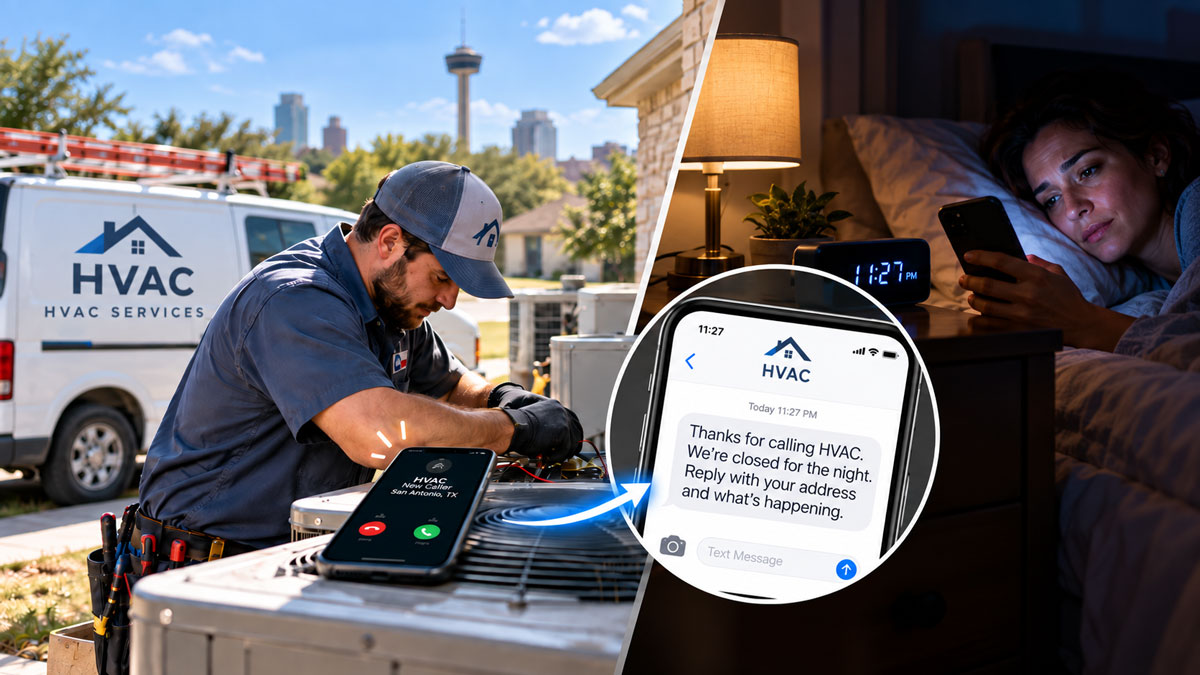
“Thanks for calling [Shop Name]. We’re closed for the night, but we got your call. Reply with your address and what’s happening (no cool, no heat, leak, noise) and we’ll text you first thing in the morning with a time. If it’s an emergency, reply EMERGENCY.”
A few things that message does right:
- It confirms you got the call. They’re not wondering if it went through.
- It collects what you need. Address and symptom means you can plan your morning before you’re out of bed.
- It gives a specific next step. “First thing in the morning with a time” is a promise you can keep. “Someone will reach out” is not.
- It gives emergencies a lane. If you run nights, that reply can route to whoever’s on call. If you don’t, you can still decide in the morning who gets the first slot.
Then actually follow through. If the text says “first thing,” the first thing you do with your coffee is answer those threads.
Part 4: When to call back vs. when to text back
Once the lead replies, you have a choice. Here’s a simple rule set:
- Text back when you’re still on the job. A two-line text (“Can do today between 3 and 5 — does that work?”) keeps the lead warm without walking away from the customer in front of you.
- Call back when it’s urgent or complicated. No heat with a newborn in the house, water on the floor, an elderly homeowner in summer heat, or a big replacement conversation. Those deserve a voice as soon as you can step away.
- Match the customer. If they texted you a paragraph, they’re fine texting. If they replied “please call me,” call them.
- Lock a window in writing. However you talk, end with a text confirming the day, time window, and address. Fewer no-shows, fewer “I thought you said Thursday.”
The text-back buys you time. It doesn’t replace a phone call when a phone call is the right move.
What a day looks like with this system
It’s 1:40 p.m. You’re on a rooftop condenser in Stone Oak. Your phone buzzes in your pocket.
The call rings you and your office line at the same time. Your wife is at the kid’s pickup and can’t grab it either. After a few rings, it rolls over. Within a minute, the homeowner gets your text: “Sorry we missed you, we’re on a job — what’s going on with your system?”
She replies: “AC blowing warm, upstairs is 84.” When you climb down twenty minutes later, the thread is waiting. You text: “I can be there between 4 and 6 today.” She says yes. Booked, without leaving the job you were on.
That night at 9:30, another call comes in. Nobody answers. The after-hours text goes out. By morning you have an address in Alamo Heights and “furnace making a loud noise.” You text at 7:15 with an 8–10 window. That one’s booked before your first job starts.
Same two calls that would’ve been voicemails. Different outcome.
What NOT to do
Some habits quietly kill leads. If any of these sound familiar, they’re worth fixing first:
- Silence. A call that rings out with no voicemail, no text, and no follow-up is the most expensive call you’ll ever miss.
- A full voicemail box. The caller hears “mailbox full” and moves on. Clear it or turn it off and let the text do the work.
- Vague promises. “We’ll call you back” with no time attached sounds like “maybe.” Give a window: “within the hour,” “first thing in the morning.”
- Texts with no name. A random number texting “Missed your call” looks like spam. Always lead with your shop name.
- “Call back during business hours.” You just told a homeowner with a broken AC to wait until tomorrow and do the work themselves. Most won’t.
- Promising what you won’t do. If your auto-reply says “someone will call within 15 minutes” at midnight and nobody does, that’s worse than an honest “first thing in the morning.”
Common objections (quick answers)
“I can just call everyone back when I’m done.” You can, and you should. The question is whether they’re still waiting. A first-minute text keeps them waiting for you instead of calling the next shop.
“My customers are older. They don’t text.” Some prefer calls, and that’s fine. The text doesn’t stop you from calling. It just means your first touch isn’t silence. Plenty of homeowners who’d never leave a voicemail will tap out a quick reply.
“I don’t want to be on call 24/7.” You don’t have to be. The after-hours auto-reply exists so you can be off. It holds the lead and collects details while you sleep.
“This sounds like a lot of setup.” It’s a few decisions and two text templates. Once it’s running, you don’t think about it. You just see replies show up.
Set it up this week: a short checklist
- Decide who your business line rings during the day, and whether a second phone should ring at the same time.
- Cap the rings before a call rolls over. Don’t let it ring forever.
- Decide honestly whether you take emergency calls after hours, and who’s on call if you do.
- Write your on-the-job missed-call text (shop name, “on a job,” one easy question).
- Write your after-hours text (confirm the call, ask for address and symptom, give a specific morning time, emergency lane if you offer one).
- Clear your voicemail box, or let the text replace it.
- Make “answer overnight texts” the first task of every morning.
Want to see what those missed calls may already be costing you? Run your numbers through the free Calculate Your Missed Revenue calculator. It takes about a minute.
Where Ravecode fits
You can run parts of this system by hand. The piece that’s hard to do by hand is the first-minute text, because by definition it has to happen while you can’t touch your phone.
That’s what Ravecode installs for San Antonio home-service shops, HVAC first: automatic missed-call text-back on your business number, on-the-job and after-hours message templates written for HVAC calls, and simple follow-up you can run from your phone. You keep the conversation. The system just makes sure it starts.
If you want to see exactly what happens when a customer calls, you miss it, and they get a text in under a minute, reach out for a short demo.
Next week, we’ll break down what a missed-call text-back setup actually costs, and the details of the founding offer for San Antonio shops.
- Teléfono: (210) 796 6235
- Ubicación: San Antonio, TX